
Most leaks that reach a ceiling tile on a flat roof began at a termination, not in the middle of a sheet. A gap at a wall base, a split around a pipe boot or a shrunken corner at a curb can let water into the building while the field of the membrane looks perfect. Henderson roofs face a hard test for those details: the city's emergency guidance calls daytime highs past 110°F a regular summer event in the Mojave Desert, and monsoon storms between July and September can drive heavy rain at the same joints that spent the afternoon expanding in the heat.
Our crews inspect and rebuild failed flashings on commercial roofs across Henderson, NV, both low-slope and metal. Share plans, leak dates and any earlier sealant repairs, and the inspection can aim at the junctions most likely to be letting water.
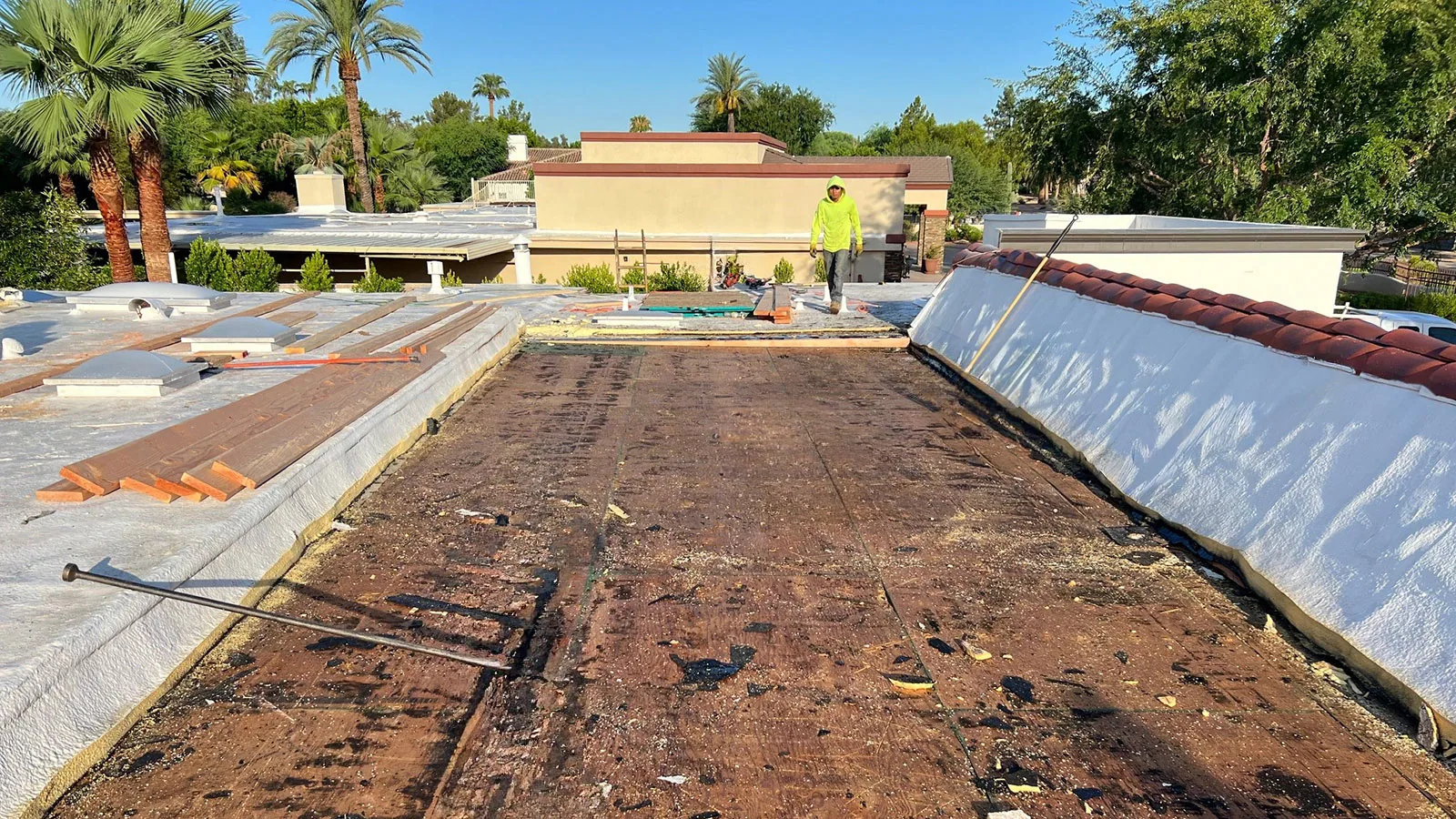
Recognize the Signs at Each Termination
Flashing is the material that turns a membrane up a wall, around a curb or over a penetration and seals the edge. It fails in a few recognizable ways. Sealant cracks and pulls away from the substrate. The membrane shrinks or tears at a corner where it was stretched. A termination bar loosens and leaves the top edge open. Metal counterflashing rusts or separates from the wall. Pipe boots crack from sun exposure and let water run down the pipe.
We look for those signs at walls, parapets, curbs, vents, pipes, drains, scuppers and skylights, and we note whether the damage is isolated or repeated across the roof. A single cracked boot is a small repair, while open seams next to it call for a wider look. The same crack at every boot of the same age is a pattern that says the material has reached the end of its service life, and replacing them together costs less than visiting each leak in turn. Photographs tie each finding to a roof zone and a numbered detail.
Follow the Water Path Behind the Flashing
A flashing works as a system of layers. The membrane base sheet runs up the vertical surface, the termination secures its upper edge, and counterflashing or a cap sheds water over the top. If any layer fails, water can slip behind the next one and travel along the substrate to an unexpected place inside. That is why a stain on a ceiling may sit several feet from the failed joint.
Movement is the force that breaks most flashings. The roof deck, the wall and the equipment each expand and contract at different rates, and the joint between them takes the difference. Henderson's heat produces large daily swings between a hot surface in the afternoon and a cooler one at night, so a rigid sealant bead is asked to stretch and compress every day and every season. A flexible flashing detail, with a membrane that has enough slack at the corner, handles that movement better than a hard bead of caulk.
Check the Substrate Before Replacing the Detail
A new flashing is only as good as the surface it bonds to. Before repair, we check the wall for crumbling mortar or cracked stucco, the curb for rust or rot, and the deck edge for wet insulation. Where the termination sits on masonry, we test whether moisture is coming through the wall itself, since a cracked parapet cap can look like a flashing failure when the flashing is sound. An infrared moisture survey shows whether water has spread into the insulation near the detail, and the answer determines how far the repair must go.
We also pull sample sections of sealant to see whether it still bonds, and press on the membrane near the edge to find lifted areas. The written findings list each flashing by location, type, condition and recommended action so the owner knows which are urgent and which can wait for the next maintenance visit. Where the flashing meets edge metal, the details of coping, gutters and edge metal are checked as part of the same walk.
Rebuild the Detail Rather Than Cover It
A bead of sealant over a failed flashing is a temporary measure, and the next hot season will crack it again. A proper repair removes the failed material back to a sound edge, cleans and repairs the substrate, installs new flashing in the same family of material as the field, and finishes with a termination bar and sealant at the top. Seams in a thermoplastic membrane are heat-welded, and in a modified bitumen system they are torched or adhered, so the new piece becomes part of the roof instead of a patch beside it.
Where several details have failed, we compare a spot repair with replacing the flashings on the whole roof. When the field membrane is sound, new flashings can extend its life by years. When the field is also near the end, the report sets out a comparison with a commercial roof replacement. Skylights and roof penetrations are their own category, and skylight and penetration flashing gets specific attention because a missed detail there can let water in again.
Decide What Waits and What Cannot
Not every flashing defect needs an immediate repair. An open termination at a wall that drains away from the building may wait for the next maintenance visit. An open boot over an occupied room, or a separated corner on a curb that serves rooftop equipment, should be closed soon. The inspection record ranks each item by the consequence of a leak at that point, so an owner can spend first where water would do the most harm.
The Galleria at Sunset and the Sunset Industrial Corridor are named areas inside the Eastside Redevelopment Area, and wherever a roof carries rooftop equipment that is serviced often, crews step near curbs and flashings again and again. We note the foot traffic, add walk pads where the path crosses a detail and recommend a maintenance visit after storms to confirm the details are still tight. If the same joint fails again, the cause is investigated before the next repair.
Coordinate Equipment and Access
Flashing work often involves other trades. Rebuilding a curb detail may require a mechanical contractor to disconnect or lift a unit, and an electrician may need to move a conduit. We set the sequence in advance, name who owns each penetration and agree on the hours when the roof is open. Where the work is near a punctured or worn membrane, we repair both in the same visit so the area is closed only once.
Share the leak dates and the roof plan
Send roof plans, leak dates, previous sealant repairs, equipment changes and building hours. We will inspect the terminations, document each failure and set the repair boundary.
Related Roofing Work
More roofing work and building types connected to this page.